About
A register of professionals, and a standard they are held to
Built in Botswana, designed for cross-border work. Chito publishes an operating specification, checks people against it on a live call, certifies them on remote practice, and introduces them to employers who want a short register rather than a bidding site.
The name
Where Chito comes from
Chito is drawn from ntchito, the Chichewa word for work, spoken across the Southern African region. It is said en-CHEE-toh.
Spell it and say it plainly as "chito" and you are more than welcome - that is exactly what it is there for. Those who know the word simply hear the full ntchito behind it. A local word for work, for a platform that is about exactly that.
The problem, stated plainly
A firm of four to forty people that wants an operations coordinator, an accountant, a developer or a marketer has two bad options.

Open freelance boards return hundreds of applicants and put the entire screening cost on a buyer who has no recruiter and no time. Employers of record solve compliance properly, but they are built for enterprise headcount and the overhead makes no sense for one good hire. Neither of them tells the buyer anything about how the person on the other end actually runs their operation.
Botswana, meanwhile, produces more qualified professionals in these fields than its domestic market absorbs, and their market has been a global one for years. What has been missing is not capability and it is not ambition. It is a route to the buyer that does not run through a bidding site, and a way of stating a professional standard that a buyer can check rather than take on trust.
What Chito does about it
It writes the standard down, checks people against it, and publishes both.
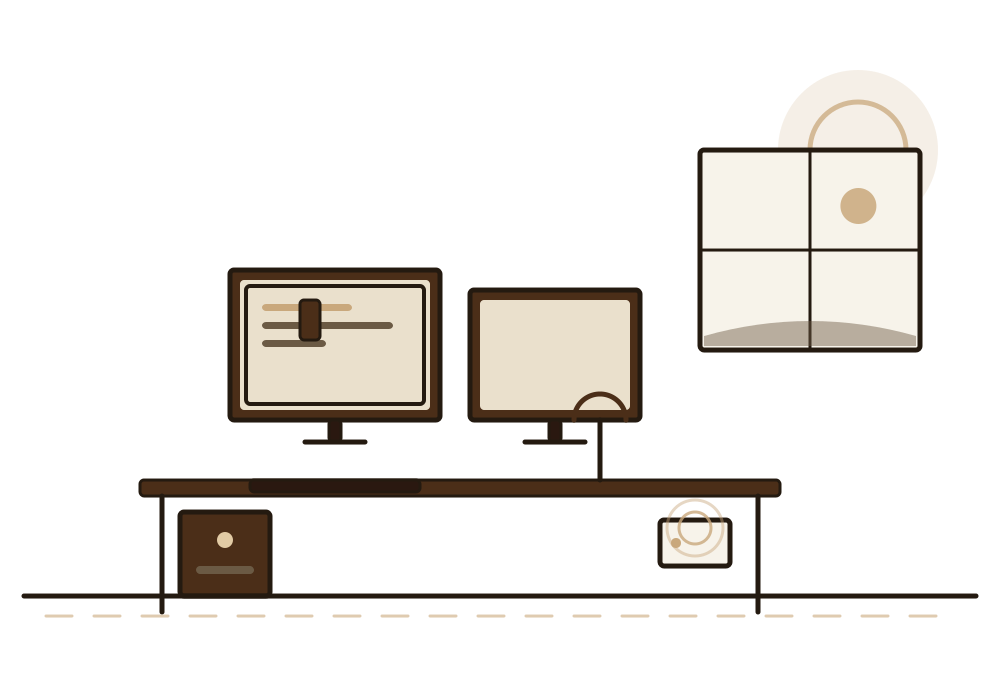
An operating specification is what separates a professional from an amateur in any market on earth. One connection with no backup, or a machine that cannot hold a clean client call, is a weak setup in Lisbon, in Manila and in Ohio. That is a trade observation, not a regional one, and every serious operation - a studio, a practice, a workshop - already runs to a specification of some kind.
What is unusual about Chito is not that people are held to one. It is that the specification is written down, demonstrated live to a named coordinator, dated, re-checked, and published in full so anybody can measure it against anybody else's. A professional does not appear on this register because they said they were ready. They appear because someone checked, and the date is on the listing. The standard is published in full.
Not a training academy
Chito is a filter over competence that already exists. If a candidate cannot swim, they must go and learn elsewhere. This is reserved for people ready to enter the water.

There is one thing we do teach, and the line is worth stating exactly. Chito does not teach anybody their trade and does not certify occupational competence - we do not make a person an accountant or a developer, and nothing we issue says we did. What we do teach and examine is remote practice: how an already-qualified professional communicates, operates and delivers at a distance. A brilliant analyst who has never worked remotely is still a brilliant analyst. They are simply not yet ready, and readiness is a separate thing that can be taught in four hours. The certification, in full.
That restraint is not modesty, it is capacity. The constraint on this whole business is the number of forty-minute verification calls one coordinator can hold in a week, which is about twelve. A platform that also taught people their trades would do neither thing properly.
Chito is not, and will not become
- An employer of record. No employment relationship with anybody, in any jurisdiction
- A payroll processor. No cross-border tax, no withholding, no money transmission
- An escrow or payment rail. No client funds, no float, no chargeback exposure
- A training institution. No trade curriculum, no accreditation, no occupational qualification
- A management tool. No time tracking, no keystroke logging, no screen capture
- An agency of record. No representation, no exclusivity, no placement warranty
Each exclusion removes a specific legal or operational liability. Together they are the reason this can run at a flat fee rather than a margin, and the reason the employer and the candidate sign their own agreement with Chito named in neither.
Why Chito exists
A system that came out of practice, not a report
Chito was not designed from a study about the future of work. It came out of more than a decade of actually doing cross-border work - as the person delivering it, then as the person managing it across countries, then as a member of distributed international teams, and finally as the person hiring for it.

In 2011, from Zimbabwe, its founder was contracted by an American business to build three e-commerce stores carrying around twelve hundred products, with no team around him. The lesson was not that a website can be built from another country. It was that working remotely forces an operating discipline on you - understand the brief, manage the project, report progress, solve problems alone, protect the deadline - and that this discipline is not the same thing as being good at the work. That distinction is the reason Chito separates competence from remote readiness.
Between 2019 and 2021, running magazine operations from South Africa with interns in Botswana and contributors tied to editions in twelve countries, the same problem appeared from the other side. Structuring work so that people in other countries know what is expected and produce to a common standard is its own skill, and an employer who lacks it will fail a good remote hire. That is why the Employer Playbook exists and is given away.
Later engagements put him inside the modern version of the thing - managing a CRM for a business in California, running digital marketing for another in Delaware and Chicago, all from South Africa, and working within an Ireland-based team whose people sat in New York, Johannesburg, Pakistan, the Philippines and Australia. Different countries, different clocks, different working cultures, and the work still had to move. None of that tooling was learned in a classroom. It was learned because the work demanded it, which is exactly where Chito's test of remote readiness comes from.
Then came the moment that actually started this. Interviewing in Gaborone, a candidate arrived for a vacancy they were not suited to - one of many applying wherever an opening might exist. The ordinary response is to reject and move on. Instead they were introduced to a client in another country, they clicked, and they began working that same afternoon.
Talent can appear in the wrong queue. Somebody can be wrong for the vacancy in front of them and exactly right for an employer a thousand kilometres away. What is missing in that gap is rarely training. It is discovery, verification, trust and matching - which is the entire job description of this platform.
Who owns it, and who runs it
Chito Africa is a BeanBreaker.com product. In Africa it is built and run by Cabanga Platforms.
A standard is worth exactly as much as the institution enforcing it. That is why this sits inside a publishing group rather than standing alone: a group already running verified registers in trade goods, minerals, livestock, freight and training has a name at stake every time it stamps something, and a new domain with a logo does not.